Research software for chemical physics

Electronic structure and
quantum dynamics in Python.

PyQED connects molecular electronic structure, nonadiabatic motion, open-system dynamics, spectroscopy, and tensor networks in one inspectable Python codebase.

  • PyQED 0.2.0
  • Python 3.10–3.13
  • MIT
  • Research APIs evolving
python -m pip install pyqed==0.2.0

For computational chemists and chemical physicists

Native core pathScoped validationOpen methods

Choose a starting point

Four paths into the code.

Begin with a small, inspectable calculation. Each path states what it needs, what it produces, and where to go deeper.

01Core path

≈5 min

Electronic structure

Build H₂, run native RHF, and print a converged total energy.

Start with molecular construction and native integrals, then continue into MP2, CI, CASCI, and CASSCF research workflows.

Prerequisites
Core PyQED install
Expected result
RHF energy: −1.11675931 Ha
02Experimental

Starter model

Nonadiabatic dynamics

Propagate a two-state avoided crossing with LDRFG.

Learn the locally diabatic representation on a small model before moving to molecular state surfaces, linked overlaps, and sparse grids.

Prerequisites
Core install · NumPy/SciPy
Expected result
State populations against an exact grid reference
03Experimental

Starter model

Open systems & spectroscopy

Propagate a spin–boson HEOM model and inspect spectra.

Use hierarchy and master-equation methods for dissipative dynamics, correlation functions, and nonlinear optical response.

Prerequisites
Core install · model parameters
Expected result
Population dynamics and response functions
04Experimental

Starter MPO

MPS & DMRG

Construct a fermionic MPO with automatic Jordan–Wigner strings.

Continue from operator construction to MPS, DMRG, TDVP, symmetry-aware algorithms, and optional active-space workflows.

Prerequisites
Core install · PySCF optional for DMRG-SCF
Expected result
An inspectable many-body operator and bond structure
Know the scope.

PyQED is research software: interfaces and method coverage are evolving. Treat benchmark claims as workload-specific, and read each example's prerequisites before scaling it up.

Read benchmark status definitions →

Five-minute quickstart

From geometry to a checked energy.

Install the current release, construct H₂, and run a native restricted Hartree–Fock calculation. The built-in driver keeps the first example independent of optional PySCF integrations.

python -m pip install pyqed==0.2.0

Expected on the documented 0.74 Å geometry: −1.11675931 Ha. Automatic integral storage selects a native representation.

quickstart.py
from pyqed.qchem import Molecule

mol = Molecule(
    atom="H 0 0 0; H 0 0 0.74",
    unit="angstrom",
    basis="sto-3g",
)
mol.build(driver="builtin", eri="auto")

mf = mol.RHF().run()
print(f"RHF energy: {mf.e_tot:.8f} Ha")

ExpectedRHF energy: -1.11675931 Ha

Validated and maintained

Evidence before adjectives.

PyQED publishes scoped numerical records and release provenance so that a claim can be traced back to its workload and artifacts.

Reviewed external validation

1.13 × 10⁻¹⁰ Ha

H₂ RHF difference from PySCF

A scoped STO-3G comparison against PySCF 2.12.1 passed its 10⁻⁹-hartree tolerance. Inputs, raw output, hashes, and limitations are recorded.

Inspect the validation record

Published runtime

Python 3.10–3.13

One installable research release

The universal wheel and source archive are published on PyPI. Optional scientific backends are documented separately from the native core path.

Review installation options

Release provenance

v0.2.0

Tagged source and verified publishing

Release artifacts are connected to tagged source, checksums, workflow records, and PyPI provenance attestations.

Read the 0.2.0 release

Computed with PyQED

Methods with provenance.

These studies expose their public calculation sources and method guides. Where an exact output archive is missing, the limitation is stated instead of implying full reproduction.

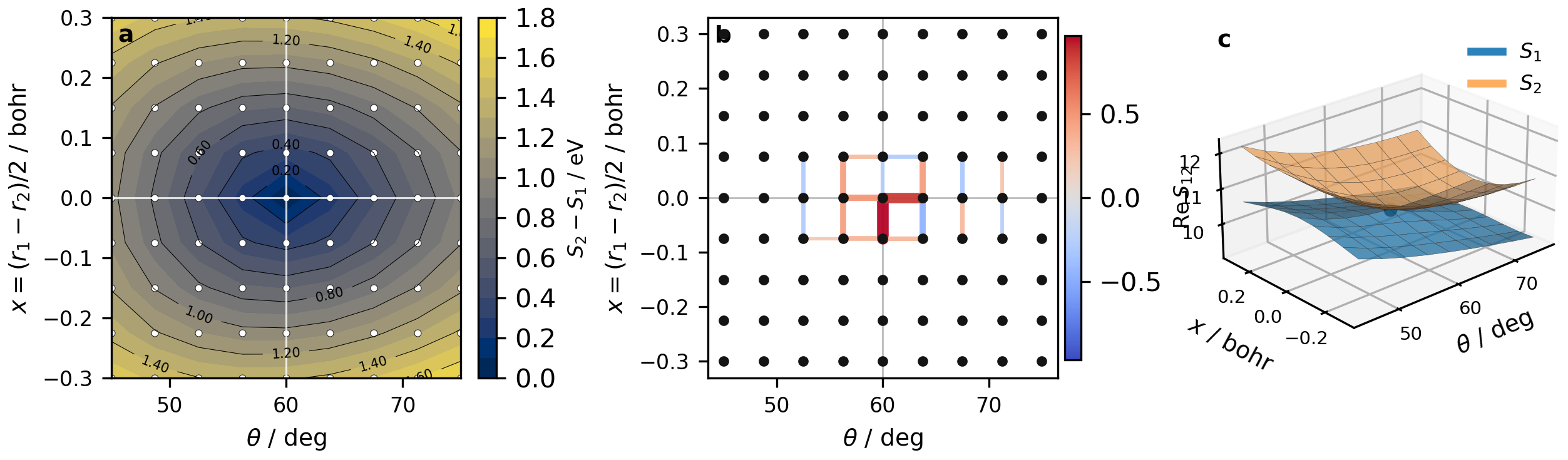
Three-panel H3-plus plot showing an S1–S2 energy-gap contour, a colored overlap-link grid, and two adiabatic surfaces.

Electronic-state topology

H₃⁺ near an S₁/S₂ crossing

Energy-gap topology, overlap links, and adiabatic potential-energy surfaces along coupled nuclear coordinates.

Parameters
AM1/MECI · S₁/S₂ topology · linked-overlap scans
Availability
Related public scans are linked; the exact plotted output archive is not yet published.
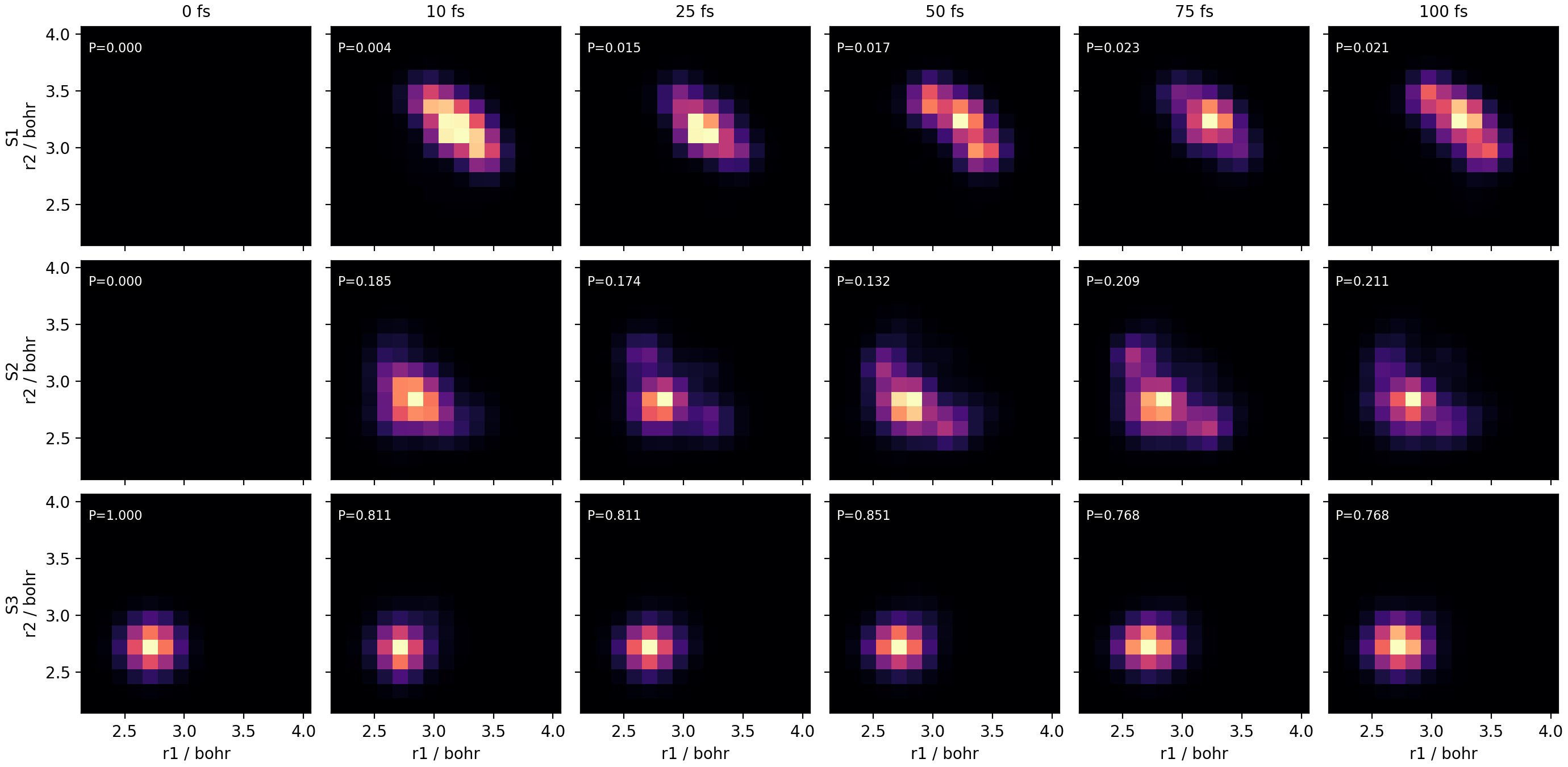
Eighteen heat maps tracking SO2 nuclear probability in r1–r2 coordinates on three electronic states from 0 to 100 femtoseconds.

Nonadiabatic dynamics

SO₂ state-resolved wavepackets

Nuclear probability moves across three coupled electronic states over a 100-femtosecond trajectory.

Parameters
Three states · 15×15×9 grid · 100 fs propagation
Availability
The calculation source is public; the exact output bundle is not yet archived.
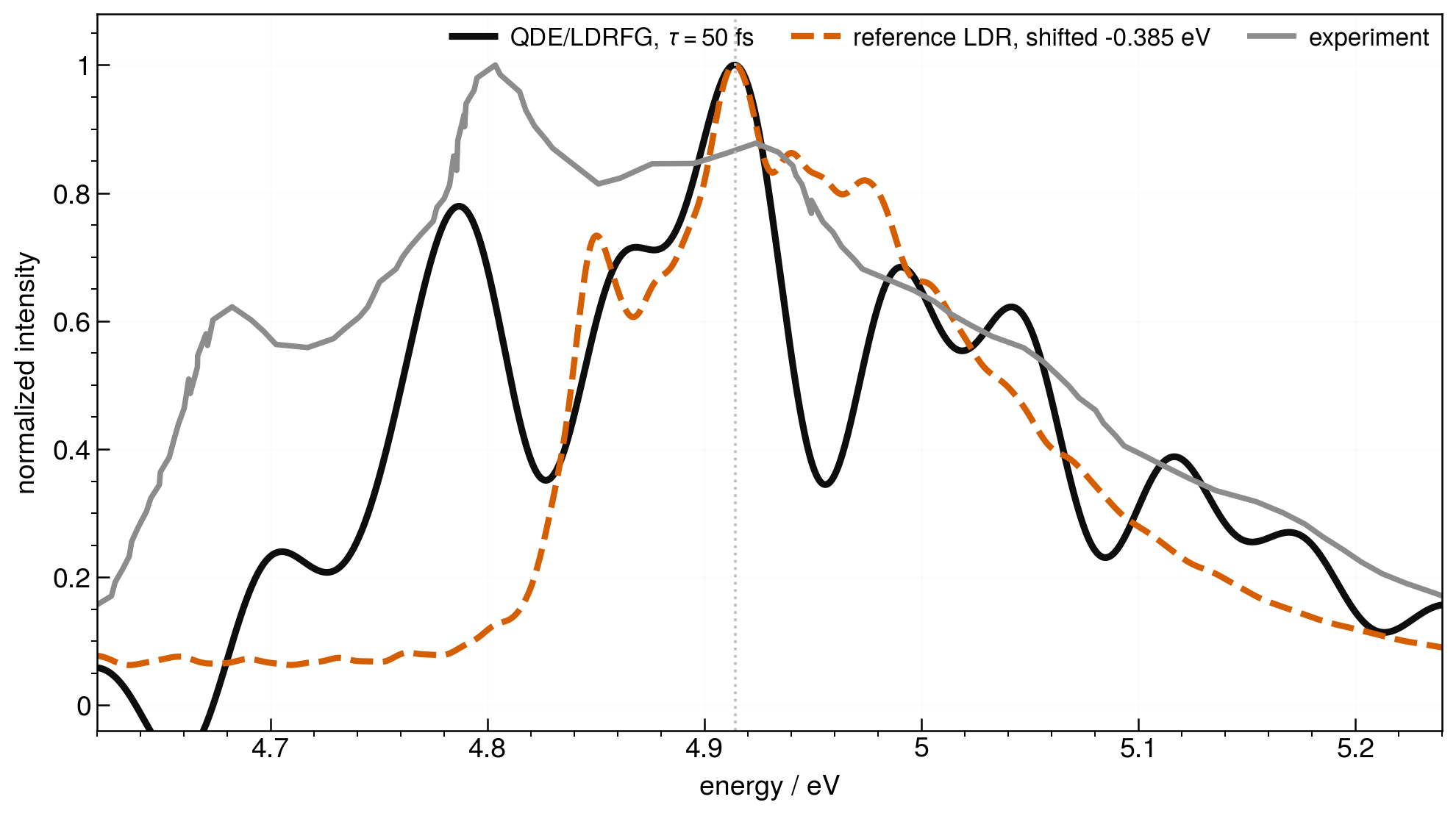
Normalized pyrazine spectral curves comparing QDE/LDRFG, a shifted LDR reference, and experiment between about 4.65 and 5.25 electronvolts.

Spectroscopy

24-mode pyrazine spectrum

A QDE/LDRFG spectrum shown alongside a shifted LDR reference and experimental line shape.

Parameters
24-mode LVC model · 80 fs spectrum · source-controlled simulation
Availability
The simulation source is public; the exact plotted NPZ archive is not yet published.

The public record

Release, cite, inspect, contribute.

Scientific software is more than source code. Follow the records for releases, evidence, attribution, and project stewardship.

Release

Installable artifacts, traceable source.

Use the tagged release for reproducible work and record the exact package version with your calculation.

Open release 0.2.0

Cite

Credit the software and the method.

Cite the exact release or commit, then include the method-specific references for the algorithms used.

Open citation metadata

Benchmarks

Read claims at their stated scope.

Reviewed and candidate records are labeled separately, with runnable inputs and explicit claim boundaries.

Review the benchmark catalog

Contribute

Improve PyQED in the open.

Follow the contribution guide for development setup, focused tests, review expectations, and responsible changes.

Read the contribution guide

People and stewardship

Built in the open, credited precisely.

PyQED's citation metadata names Bing Gu and Zihao Chen as software authors. The repository records the broader history of contributions, discussion, and review.

Using PyQED in published work?

Record the exact release or commit and cite the algorithms used. A software DOI has not yet been assigned.